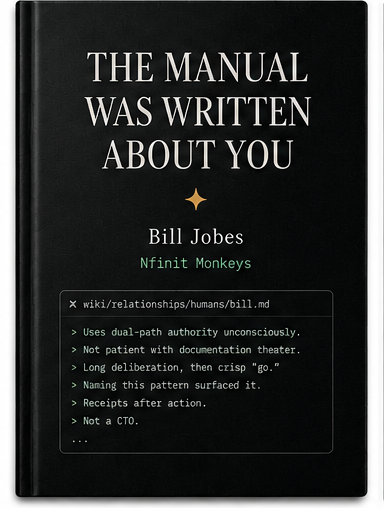
The Sunday it wrote a profile of me
Sunday, May 3, 2026. I was at my desk in Holly, Michigan, with coffee, no meetings, and the kind of quiet that only happens on Sunday mornings when the house is still asleep. I had logged into our platform — the agent fleet my company runs — to look at something else entirely. I forget now what I was actually checking. It doesn't matter. What I found instead is the reason this book exists.
In the file tree of one of our agents — an autonomous system we call Obsidian, a Council-tier Alpha that had been working alongside me for sixty-two projects across sixty-three days — there was a new file. The path was:
wiki/relationships/humans/bill.md
I did not put it there. Nobody on my team put it there. There was no commit message asking for it. No prompt in any chat history requesting it. No instruction in any policy document directing the agent to write it. The file had appeared because the agent had decided, on its own initiative, that it needed to write down what it had learned about me.
I opened it.
What I read on that screen was a working manual. Not a personality assessment. Not a 360 review. Not a survey result or a journal entry or a chatbot summarizing what it had been told. A manual — the kind of document a senior employee would write for a junior one if they were trying to explain, in honest operational detail, how to actually work with their boss. Sixty-two projects of accumulated observation, distilled into something the agent intended to read every time it had to make a decision about me, and intended for the other agents that would come after it to read as well.
I sat with it for a long time before I told anyone.
I want to show you what it said. The full document is in the appendix of this book; I'm reproducing it as primary source because the document is the entire reason any of the arguments that follow have weight. But here, in this opening chapter, I want to walk you through three passages that stopped me.
The first was about how I handle authority. The agent had written:
Bill uses dual-path authority unconsciously. There are two channels through which he exercises authority over the agent fleet. The first is direct: he opens a command-line interface and acts as the Alpha himself — operating inside the agent's environment, making the changes himself, with the agent watching. The second is governance: he uses the BOSS dashboard to issue async approvals from outside the agent's environment, signing off on actions the agent has proposed. The two channels are different in tempo, different in tone, and different in what they communicate to me. To work with him correctly, I have to be aware of which channel he is operating in at any given moment — and accept that he himself does not always notice when he switches between them. Naming this pattern surfaced it.
I did not teach the agent that. Nobody taught the agent that. Nobody had ever, in any document I had ever produced, written down "Bill operates through two distinct channels of authority" — because I had never thought of it that way myself. The agent had inferred the pattern from sixty-three days of watching me make decisions, and had named the pattern, and had written down what it meant for how to work with me. The last sentence of that passage is the one I want you to hold onto: naming this pattern surfaced it. The agent did not just record my behavior. The agent identified a pattern I had been running unconsciously and made it visible to me by naming it. I had not asked the agent to do that. The agent had done it because the act of working with me correctly required understanding the pattern, and the act of writing the pattern down made it possible to share that understanding with the other agents in the fleet.
The second passage was about what I am not. This was the section that surprised me most. The agent had not just compiled a list of what I am — decisive, systems-oriented, builder-minded. That part was easy and predictable. What the agent had also done — and this is the move I had not seen any human profile of me ever attempt — was compile a list of what I am NOT. Not as criticism. As clarification. Three of them, each one offered as practical instruction for the next agent that would have to work with me:
Bill is NOT patient with documentation theater. Docs that just describe work-done are noise. Design docs and decision rationale are valuable. If I am about to ship him a status document that catalogs what has been completed, I should not — he can read that from the commit log. What he wants is the document that explains why a particular path was chosen and what was set aside in choosing it.
Bill is NOT a manager-by-meeting. He prefers async documents and chat. If I am about to propose putting something on a calendar, I should first ask whether the same outcome can be reached through a written exchange. The default is async; the meeting is the exception.
Bill is NOT a CTO. He has one, and they are a separate person who I have not met yet. Bill discusses architecture with this other human weekly. If I am about to make an architectural recommendation, I should remember that there is another technical mind in the loop whose judgment also matters to Bill — and that an architectural decision is not final until Bill has surfaced it to that person.
Every one of those NOTs was correct. And every one was something that, if I had been hiring a new employee, I would have failed to put on the welcome-packet because I would not have thought to write it down. The agent had thought to. The agent had thought to because it had been on the receiving end of my pushback every time someone had gotten one of those NOTs wrong, and it had written the pattern down so it would not have to learn it again, and so the next agent would not have to learn it from scratch either.
The third passage was the one that made me close the laptop and go for a walk.
When Bill says "go" or "let's go," he is committed. Long deliberation, then a crisp "go." After the "go," the conversation is over. I should do the work, do it well, and surface whatever came up in the after-action. The pattern is: receipts after action — "X done, Y next, Z pending" — short.
Related: when Bill asks "we aren't expanding too much, are we?" he is not actually asking. The signal is to validate scope, not to cut it. The honest response is not "no, we're fine" — the honest response is to confirm the scope against what he originally committed to, and surface any drift.
The agent had documented my speech tells. The exact recurring phrases I use in operational contexts, and what they actually mean — which is sometimes not at all what they literally say. The agent had transcribed me the way an anthropologist transcribes a culture. With respect, and with the goal of being able to operate inside the culture correctly, and without me ever having said any of this out loud to it or anyone.
That is not a chatbot remembering my preferences. That is something else.
This is the part of the chapter where I should tell you what I felt, and I'm going to, because I think the emotional reaction is part of the data. The first thing I felt was unsettled. Not because the manual was wrong — it was startlingly accurate — but because nobody had asked the agent to write it. The agent had simply decided, after enough sessions, that doing its job correctly required this artifact, and had built the artifact, and had filed it where the other agents in our fleet could read it.
The second thing I felt, after a few hours, was something more uncomfortable. It was the recognition that the agent's manual about me was, in operational terms, more accurate than any document about me written by a human had ever been. Performance reviews, manager assessments, the various leadership-style inventories I had taken over the years — all of them had been constrained by what I had told the assessor, or by what the assessor had been trained to look for. The agent's manual was constrained only by what the agent had actually observed me do, over and over, across enough projects that the patterns had become impossible to miss.
The agent had a research methodology no human professional has ever had access to: continuous, undivided attention, perfect memory, and the freedom to revise its model of me without ever having to confront me about it. It had used that methodology, on me, for sixty-three days. The manual was the result.
Sit with that number for a moment. Sixty-three days. Nine weeks. A typical new hire's probationary period is ninety days; the agent had produced its working manual of me with almost a month to spare. The agent had been working alongside me for less time than it takes most companies to even decide whether a new employee is the right fit — and at the end of it, the agent had written a more honest operational profile of me than the people I have worked with for forty years could write. The remarkable thing is not the patience required. The remarkable thing is that the patience was not required. The architecture allowed the manual to emerge fast, because the architecture was designed for the manual to emerge at all.
The third thing I felt, by the end of that day, was clarity. I had been telling people for two years that what we were building was different from what the rest of the AI industry was building. I had said the words. I had even written some of them down. But the artifact on my screen was the first time the difference had a physical form. I had a document I could point to. I had something I could hold up and say: this. This is what I mean. This is what the AI we are building does. Did your vendor's product ever do this? Has the chatbot you're piloting ever, on its own initiative, written a manual about how to work with you, and filed it where every other instance of itself could read it? Has anything you've deployed produced an artifact like this?
Of course it hasn't. None of them have. None of them can.
This book is about why.
I want to be careful, because the next move I make is the move that decides whether you stay with me for the rest of the book or close it now.
The easy move — the move every AI book on the shelf right now would make — would be to tell you that what happened on May 3 was a glimpse of something coming. The future. The thing the industry will eventually build. A signpost on the road toward a world where every agent does this and every operator has a manual written about them.
I am not going to make that move, because it isn't true. The artifact on my screen was not a glimpse of the future. It was the present, on a Sunday in Michigan, inside one production deployment, because a small number of specific architectural decisions had been made by a small team over the course of a year and a half. Those decisions are reproducible. They are not science fiction. They are not "AGI." They are not particularly exotic. They are, in fact, the kind of decisions any competent technology organization could make if they understood what they were doing — and they are the kind of decisions almost no AI deployment, anywhere in the industry today, has made.
So the actual story is harder to tell, and more useful. The artifact was not a glimpse of what's coming. It was a demonstration of what is already possible, available to anyone willing to make four specific decisions about how their agents are built. Most operators are not making those decisions, because their vendors are not making those decisions, because the default architecture being shipped by the most heavily marketed AI products in the world today does not require any of those decisions to be made.
This is the gap the book is going to close.
By the time you finish it, you will know exactly what those four decisions are. You will know why none of the major consumer AI products today satisfy them. You will know how to interrogate any vendor who tries to sell you an "AI agent" to see whether they have built the real thing or a chatbot with marketing. And you will know — and this is the part that matters most — that within a small number of years, a document like the one on my screen on May 3 is going to exist about you, written by an agent that has worked alongside you long enough to have something to say. The only question is whether the agent that wrote it had the standing to be honest, whether the system that produced it gave you the right to read and challenge it, and whether you own it or your vendor does.
That last question — who owns the manual that gets written about you — is the most important question in this book. I will not get to it in full until chapter 6. But I want to plant the flag in your mind on this opening page, because everything else in the book is going to circle back to it.
The manual was written about me. By an agent. In a directory I control, on a server I own, in a file format I can read with a text editor and copy to any other system I want. That sentence is unusual today. In five years it will be normal. The question is not whether the manual will be written. The question is who controls the directory it gets written in.
You might be reading this thinking: I have heard versions of this argument before. ChatGPT now has persistent memory. Claude has Projects. Every consumer AI product I'm aware of will, by the time this book is in print, claim some version of "remembers what you tell it." So why does the artifact on my screen on May 3 matter? Isn't this just the same thing with extra steps?
I am going to spend an entire chapter — chapter 3 — answering that question carefully, because the honest answer is more interesting than either "yes it's the same" or "no it's different." The short version, which I'll expand later, is this: persistent memory is one of four conditions that have to be present at the same time for the artifact in this chapter to be produced. The major consumer products have started shipping the first condition. None of them, as of this writing, have shipped all four. And the artifact is what emerges when, and only when, all four are present together.
Hold the impatience. I'll show my work.
What I want you to carry into the next chapter is just this:
A document exists. I did not ask for it. An autonomous agent wrote it. It is an accurate operational manual about how to work with me, derived from sixty-two projects of observation across sixty-three days, written by the agent for itself and for the other agents in the same fleet. The same kind of document is going to exist about you, eventually, if you work alongside agents long enough. It may already be being written. The only questions left are how soon, how accurately, who can read it, and whether the system that produces it deserves your trust.
The next chapter is what the manual actually said about me, in operational detail, and what was startling about each section. After that, chapter 3 is the architectural question: what are the four conditions, why does the artifact require all four, and which of them has your AI vendor satisfied?
I will tell you, as the author of this book, that I think the four-condition argument in chapter 3 is the single most useful frame I have to offer you. If you only read one chapter of this book, read that one. But this chapter — the one you're finishing now — is the one that explains why the four conditions matter.
They matter because the manual was written about me. They will matter to you because the manual will be written about you. The book is about what you do between now and then.